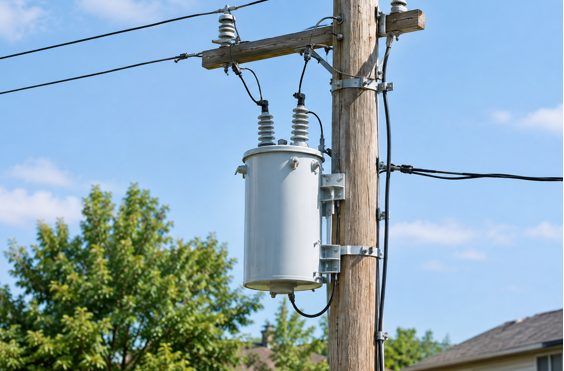
A pole mount transformer is an electrical device installed on a utility pole to reduce the voltage of electricity supplied through distribution lines to a level suitable for homes, commercial buildings, and other end users. It forms part of the electrical distribution network, helping deliver power safely and efficiently from substations to consumers.
Electricity travels over transmission and distribution networks at different voltage levels. Before it reaches residential or small commercial properties, the voltage must be reduced to match the requirements of the connected electrical equipment. This is the primary function of a distribution transformer installed on an overhead power line.
These transformers are commonly found in residential neighborhoods, rural communities, agricultural areas, and locations where underground electrical infrastructure may be expensive or impractical. Their elevated installation keeps the equipment above ground level while allowing utility crews to access it for inspection and maintenance.
How Does a Pole-Mounted Transformer Work?
The operating principle is based on electromagnetic induction. Inside the transformer, two windings—known as the primary and secondary windings—are arranged around a magnetic core. When alternating current flows through the primary winding, it produces a changing magnetic field in the core. This field induces a voltage in the secondary winding.
The number of turns in each winding determines the voltage relationship between the input and output. A transformer designed for distribution typically has more turns in its primary winding than in its secondary winding, allowing it to reduce voltage.
For example, a distribution network may supply electricity at several thousand volts, while the transformer reduces it to a utilization voltage suitable for local consumers. The actual input and output ratings depend on the utility network and the country where the equipment is installed.
The transformer does not generate electricity or provide energy storage. Instead, it changes voltage levels while transferring electrical power between circuits. Some energy is lost as heat due to winding resistance, magnetic effects, and other operating factors.
See also: Why are wildlife boat tours becoming a must-do experience in Western Australia?
Main Components and Their Functions
Understanding the main components helps explain how a transformer operates and what maintenance teams inspect during routine servicing.
Magnetic core: The core provides a path for magnetic flux between the windings. It is commonly constructed from laminated electrical steel to limit energy losses.
Primary and secondary windings: These conductors transfer energy through electromagnetic induction. Their design depends on the required voltage, current, and power rating.
Insulating system: Insulation separates electrically active components and prevents unwanted current flow. Many distribution units use insulating oil for both electrical insulation and cooling, although dry-type designs also exist for certain applications.
Transformer tank: In oil-filled equipment, the tank contains the core, windings, and insulating liquid. Its construction must withstand the intended operating conditions and environmental exposure.
Bushings and terminals: These provide insulated connections between the internal windings and external conductors.
Protective devices: Depending on the design, protection may include fuses, surge arresters, pressure-relief devices, and temperature-related safeguards. These components help address faults, lightning-related surges, and abnormal operating conditions.
Common Types Used in Electrical Distribution
Utilities select transformer designs according to the required capacity, installation environment, network configuration, and maintenance requirements. Single-phase units are frequently used for individual residential connections, while three-phase arrangements serve larger loads and commercial or industrial applications.
The term pole transformers generally refers to distribution transformers installed on utility poles. These units vary in voltage rating, capacity, insulation system, and construction.
A pole mounted transformer may use an oil-filled design for outdoor distribution or another configuration suited to the relevant electrical network. Selection depends on load requirements, applicable standards, climate, available mounting space, and the utility’s preferred equipment specifications.
A pole mounted distribution transformer is typically selected according to its rated kilovolt-amperes (kVA), primary voltage, secondary voltage, frequency, and impedance. These specifications determine whether the unit can serve the expected electrical demand and coordinate correctly with the wider distribution system.
Where Are These Transformers Used?
Pole-mounted equipment is common wherever overhead distribution lines provide a practical means of delivering electricity. Its applications include:
- Residential areas: Supplying electricity to houses, apartment clusters, and neighborhood distribution circuits.
- Rural electrification: Providing power to villages, farms, and properties located far from urban substations.
- Agricultural facilities: Supporting irrigation pumps, storage buildings, and farm operations where the electrical load suits the installed rating.
- Small commercial properties: Serving shops, offices, workshops, and other facilities connected to overhead distribution networks.
- Remote infrastructure: Supplying suitable electrical loads at locations where underground cabling or ground-mounted equipment may be less practical.
An overhead transformer can be particularly useful in areas with established overhead lines because it can connect directly to the distribution network without requiring a dedicated underground transformer enclosure. However, installation feasibility depends on pole strength, clearances, access, local regulations, and the electrical load.
How to Choose the Right Transformer
Choosing a suitable unit requires more than comparing purchase prices. Electrical engineers and utility planners should assess several technical and environmental factors.
Load capacity: Estimate the expected demand, including motor starting currents, peak usage, and potential future expansion. The transformer should be appropriately rated without being unnecessarily oversized.
Voltage compatibility: Confirm that the primary and secondary ratings match the distribution system and the connected loads. Frequency and phase configuration must also be suitable.
Efficiency and losses: Compare no-load losses and load losses using consistent test conditions. Lower losses can reduce operating costs over the equipment’s service life.
Environmental conditions: Consider ambient temperature, humidity, rainfall, dust, corrosion, altitude, and exposure to lightning. The enclosure, insulation, and protective accessories should suit the installation location.
Standards and certification: Verify compliance with applicable national standards, utility specifications, and relevant IEC or IEEE requirements. Documentation should include rated capacity, test results, drawings, and installation instructions.
Maintenance and service support: Review inspection requirements, spare-parts availability, warranty coverage, and the supplier’s ability to provide technical assistance.
Installation, Maintenance, and Electrical Safety
Transformer installation must be performed by qualified electrical professionals under the requirements of the local utility and applicable electrical codes. The pole structure must support the equipment’s weight and mechanical loads, while conductors and connections must meet specified clearance and insulation requirements.
Before commissioning, authorized personnel should verify the nameplate ratings, connections, protective devices, grounding arrangements, and applicable electrical test results. Incorrect connections or inadequate protection can create dangerous operating conditions.
Routine maintenance may include visual inspections for oil leaks, corrosion, damaged bushings, loose external fittings, unusual noise, overheating, and deterioration of protective equipment. Oil sampling and electrical testing may be required according to the design, condition, and utility maintenance schedule.
Only trained and authorized personnel should work on transformer installations. Equipment must be isolated, de-energized, and verified safe under established procedures before maintenance begins. Overhead lines can remain dangerous even when a transformer appears inactive, and nearby conductors may carry lethal voltages.
Final Considerations
A pole mount transformer supports the final stages of electrical distribution by reducing network voltage to levels suitable for local consumption. Its performance depends on correct capacity selection, compatible voltage ratings, suitable protection, sound installation practices, and regular maintenance.
Understanding its components and operating requirements helps utilities, electrical contractors, and project planners make better equipment decisions. Evaluating efficiency, environmental suitability, safety provisions, and compliance before installation can also reduce operational problems and support dependable electricity delivery over the equipment’s service life.
