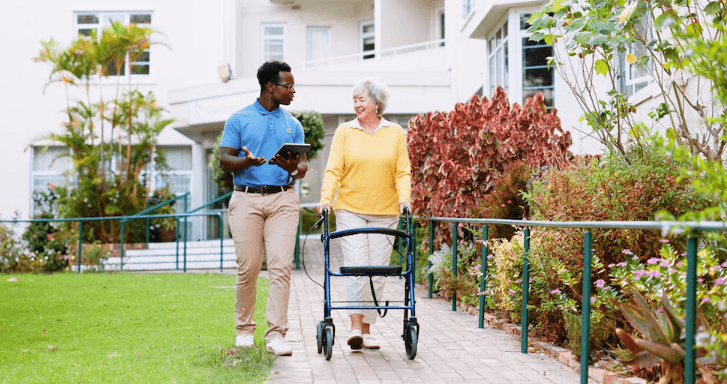
Most people want to grow old in their own home. With the average age of Australians increasing, there is a greater challenge in finding ways to enable seniors to grow old safely in their own home. One in six Australians over the age of 65 experience a fall each year that requires medical attention. With a few simple home modifications most homes can be made ‘fall safe’ to support senior members of families to live safely and independently in their own homes for as long as possible.
Foundation changes that matter most
The physical changes that occur as people age can affect how people move around in homes. For example, the loss of hand strength and grip makes it difficult to turn door handles. Reduced flexibility makes it difficult to reach for things that are stored on high shelves, and to go down low to pick things up from the floor. The slower reaction time of older people also makes it difficult for them to deal with unexpected changes in level.
Smart home modifications that matter: Door Handles: Installing lever-style door handles to properties which have arthritic residents can make a huge difference to daily living in the home as lever handles do not require the same level of grip and twisting as standard door handles. Lighting: Using motion-sensing lighting can also prevent falls as it automatically switches on when someone enters a room. A number of accidents occur as people fumble for light switches in the dark. Removing loose rugs and securing down others that may buckle and cause tripping can also prevent accidents.
Of all the rooms in the house, the kitchen is the most commonly where falls occur. This is simply because most people spend a great deal of time in the kitchen, and the majority of work surfaces in this room are at a great height. However, there are a number of common modifications that can be used to create a safe and usable kitchen space. For example, by lowering commonly used items to a work surface height or below, such as kitchen utensils, equipment, and stores, and by utilizing pull-out drawers in base cabinets rather than reaching into the back of high storage such as on top of cupboards and in on wall shelves and storage, and by placing anti-fatigue mats on the floor to cushion the joints of people who spend long periods of time on their feet while in the kitchen.
These modifications can be carried out before you actually need them because of illness or an accident.
Bathroom safety deserves dedicated focus
The bathroom is often considered to be the most hazardous room in the house. Not only are there often wet and slippery surfaces and potentially sharp edges to contend with but there are also typically small confined spaces that can cause particular problems for senior citizens in the event of a fall.
There are many types of grab rails which can be used in homes to aid in preventing falls around the home. The most common locations for grab rails to be fitted include around the toilet, in showers and around baths. It is essential that wall fixings are made into the wall studs for the best fix. The worst type of grab rail are those which are screwed into hollow drywall. These grab rails are more likely to fail when most needed.
Simple changes can be made to your shower to ensure safe use. Non-slip strips or mats can be applied to the floor and walls of the shower to prevent slips. A shower seat can be placed in the shower and used as required. It can be sat on and then stood up from. A hand-held shower head with a long handle and which can be attached to a number of different shower rails is very useful for people with limited mobility as they can direct the water flow to suit.
There are also many disability toilet aids available that can assist in making your bathroom more accessible. A raised toilet seat is a great starting point for any senior looking to maintain their independence as it enables users to sit down on the toilet and then stand up again with less distance than a regular toilet. A toilet frame is also another option to assist senior members of the family to safely transfer to and from the toilet. These toilet frames have armrests which can support the user when transferring to and from the toilet.
Lighting strategy needs rethinking
People of advancing years need a significantly greater amount of light to perform everyday tasks than their younger counterparts. In fact, a 60 year old requires about three times the amount of light that a 20 year old requires to perform similar tasks. Most homes are not designed with increased levels of lighting for people of advancing years.
Remove shadows and glare from your home to make it safer at night. Your home will become safer for older people as their eyes require more light to see as they age. Consider installing under cabinet lighting in your kitchen to bring more light to work surfaces and to remove dark shadowy areas from overhead lighting. Consider installing lights at the top and bottom of your stairs to make your time on the stairs safer at night. Outdoor lighting along paths and around the outside of your home can help to guide older people around the home at night and reduce the risk of a trip.
Technology integration that actually helps
Technology to assist seniors within their homes is changing rapidly and often now allows seniors with diminishing physical ability to operate aspects of their home by voice. Examples of smart home technology are systems that allow seniors to turn on lights, air con and heating as well as make emergency calls to family and friends. Some systems even allow two way communication with a carer or family member. There are also new and more advanced medical alert systems on the market, which have come a long way from the simple pendant worn around the neck of a senior. Many systems now have fall detection, GPS tracking and two way communication as well as mobile apps for family and carers.
Technology should support home modifications. It is no good having an app that allows you to turn lights on and off or open curtains in order to create a safe home environment. In order to create a safe home environments, modifications such as installing grab rails, and ensuring that there is adequate lighting, must be made.
See also: Why Cryptocurrency Is Gaining Popularity Worldwide
Why early intervention pays off financially
You will note that Home Modifications are often thought of in terms of expense but an assessment of the cost of an injury due to a fall is far greater. The cost for emergency treatment and subsequent surgery for a fall is between $20,000 and $50,000 per incident and in some cases may even result in long term care for the individual. This compares with the cost for total home modification of between $3,000 and $8,000 for the entire home. In some cases there are government rebates and tax deductions available for Home Modifications, and in most cases an assessment by an Occupational Therapist to identify the required Home Modifications is covered by Medicare or your private health insurance.
In many instances where you have undertaken home modifications some of these are even claimable back by rebates or be claimed as a tax deduction. An assessment of your home by an Occupational Therapist (OT) and provision of a list of suggested home modifications to make your home safe and accessible for your aging parent are generally covered by Medicare or your private health insurance.
Home modifications are about extending the independence of older people and enabling them to live life to the full as their abilities allow. Making changes to your home after an accident or fall is likely to cost more in the long run and achieve less than doing it before it is needed in an emergency.
